Have you ever struggled to connect ideas smoothly in English? Relative pronouns are your secret weapon. These small words can transform choppy sentences into elegant expressions.
Think about how we describe people and things in everyday conversations. Instead of saying “I have a friend. She lives in London,” we can say “I have a friend who lives in London.” That’s the magic of relative pronouns at work.
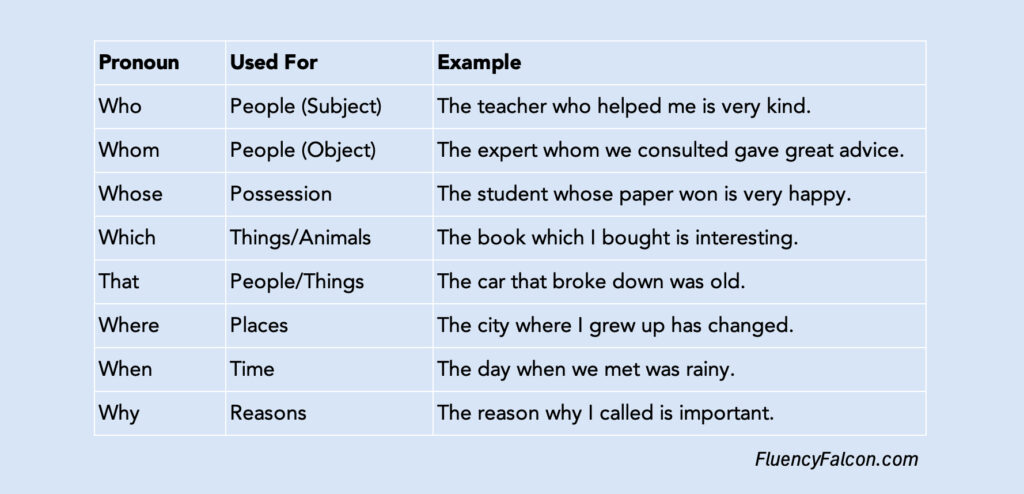
Quick Reference: Relative Pronouns Overview
What You’ll Learn
By the end of this guide, you’ll be able to:
- Choose the right relative pronoun every time
- Connect ideas naturally in your writing
- Avoid common mistakes with relative pronouns
- Sound more professional in [academic writing]
How to Use This Guide
This article is part of our comprehensive series on [relative clauses]. Start with the basic concepts and move through each section at your own pace.
Use the color-coded examples to understand different contexts. Green highlights show correct usage, while red marks common mistakes.
For best results:
- Review the overview table above
- Follow the examples in each section
- Try the practice exercises
- Check your understanding with our quick tips
Ready to master relative pronouns? Let’s dive in and transform your English writing skills.
Understanding Relative Pronouns
Ever noticed how some words help us avoid repeating information? That’s where relative pronouns shine. These clever connectors help us join ideas seamlessly.
What Makes a Pronoun “Relative”?
A relative pronoun creates a special relationship between parts of a sentence. It connects a [dependent clause] to the main clause by referring back to a previous noun.
Let’s break it down with a simple example: “The dog is happy. The dog lives next door.” ↓ “The dog that lives next door is happy.”
The word “that” relates back to “dog,” creating one smooth sentence. This connection is what makes these pronouns “relative.”
Why Relative Pronouns Matter
Clear communication depends on connecting ideas effectively. Relative pronouns help you:
- Avoid unnecessary repetition
- Create sophisticated sentence patterns
- Express complex ideas clearly
Consider how they improve [sentence structure]: “I met a scientist. She works at NASA. She discovered a new planet.” ↓ “I met a scientist who works at NASA and who discovered a new planet.”
Common Misconceptions Check
Before diving deeper, let’s clear up some confusion:
❌ Myth: “That” and “which” are always interchangeable. ✅ Truth: Their usage depends on whether the information is essential.
❌ Myth: You always need a comma before relative pronouns. ✅ Truth: Comma usage depends on the clause type.
❌ Myth: “Who” is the only pronoun for people. ✅ Truth: “Whom” and “whose” also refer to people in specific cases.
Take this quick pre-check:
- Can you spot the relative pronoun? “The book which I borrowed belongs to Tom.”
- Is this correct? “The person that whom I called wasn’t home.”
Types of Relative Pronouns
People-Related Pronouns
Let’s explore the three main relative pronouns used for people. Each has a specific role in creating clear, natural sentences.
Who (Subject)
“Who” refers to people as the subject of a relative clause.
Definition:
- Used when the person performs the action
- Always acts as the subject in its clause
- Can refer to individuals or groups
Pattern: Person + who + verb
✅ Correct: “The teacher who speaks French is my mentor.” ❌ Incorrect: “The teacher whom speaks French is my mentor.”
Quick Tip: If you can replace it with “he/she,” use “who.”
Whom (Object)
“Whom” refers to people as the object of an action or preposition.
Definition:
- Used when the person receives the action
- Functions as an object in the clause
- Common in [formal writing]
Pattern: Person + whom + subject + verb OR Preposition + whom
✅ Correct: “The expert whom we consulted gave good advice.” ❌ Incorrect: “The expert who we consulted gave good advice.”
Quick Tip: If you can replace it with “him/her,” use “whom.”
Whose (Possession)
“Whose” shows possession or relationship to people.
Definition:
- Shows ownership or connection
- Links possessor to possessed item
- Can connect multiple ideas
Pattern: Person + whose + possession + verb
✅ Correct: “The author whose book won lives nearby.” ❌ Incorrect: “The author who’s book won lives nearby.”
Things/Animals-Related Pronouns
Which
“Which” introduces additional information about things or animals.
Definition:
- Used for non-essential information
- Always preceded by a comma
- Common in [descriptive writing]
Pattern: Thing/Animal + , which + information
✅ Correct: “The car, which was red, belonged to Tom.” ❌ Incorrect: “The car which was red belonged to Tom.”
That
“That” introduces essential information about things or animals.
Definition:
- Used for essential information
- Never preceded by a comma
- Defines or identifies the noun
Pattern: Thing/Animal + that + essential information
✅ Correct: “The phone that broke was expensive.” ❌ Incorrect: “The phone, that broke, was expensive.”
Quick Reference Box:
People:
- Who → Subject action
- Whom → Object of action
- Whose → Possession

Things/Animals:
- Which → Non-essential info
- That → Essential info
Time/Place/Reason Pronouns
These relative pronouns help us talk about when, where, and why things happen. They create natural connections in our sentences.
Where
“Where” connects information about places and locations.
Definition:
- Used for physical locations
- Can refer to any place
- Works with both specific and general locations
Pattern: Place + where + situation/action
✅ Correct: “The café where we met has closed.” ❌ Incorrect: “The café which we met at has closed.”
Quick Tip: If you can replace it with “at/in which,” use “where.”
When
“When” links information about time and events.
Definition:
- Used for time references
- Works with specific dates or general periods
- Connects time-related clauses
Pattern: Time + when + event/action
✅ Correct: “The year when we graduated was 2020.” ❌ Incorrect: “The year that we graduated in was 2020.”
Quick Tip: If you can say “at that time,” use “when.”
Why
“Why” introduces reasons and explanations.
Definition:
- Used to explain reasons
- Often follows “reason” or similar words
- Creates logical connections
Pattern: Reason + why + explanation
✅ Correct: “The reason why I called was important.” ❌ Incorrect: “The reason because I called was important.”
Common Patterns Box:
Time → "The day when..."
Place → "The place where..."
Reason → "The reason why..."
Pro Tips:
- These pronouns often appear in [formal writing]
- They help create [complex sentences]
- Use them to avoid preposition overuse
Selection Guide
Decision Trees for Relative Pronouns
Choosing the right relative pronoun doesn’t have to be complicated. Follow these simple decision trees to make the right choice every time.
People vs Things Decision Tree
Start with this basic question: Are you referring to a person?
Is it a person?
├── Yes → Is the person doing the action?
│   ├── Yes → Use "who"
│   └── No → Is it possession?
│       ├── Yes → Use "whose"
│       └── No → Use "whom"
└── No → Continue to Things Tree
    ├── Is it essential information?
    │   ├── Yes → Use "that"
    │   └── No → Use "which"
Defining vs Non-defining Clauses
The information you’re adding makes a big difference in your choice.
Is the information essential?
├── Yes → It's a defining clause
│   ├── No comma needed
│   └── Use "that" (for things)
└── No → It's a non-defining clause
    ├── Needs commas
    └── Use "which" (for things)
Formal vs Informal Usage
Your writing context matters. Here’s when to adjust your choices:
Formal Settings:
- Use “whom” in object positions
- Prefer “which” with commas
- Keep “whose” for possession
Informal Settings:
- “Who” is often acceptable instead of “whom”
- “That” is common for both people and things
- Simpler structures are preferred
Quick Tips Box:
Remember:
✓ Academic writing → More formal choices
✓ Everyday speech → Simpler options
✓ Business writing → Balance both
Comparison Tables
Let’s break down the key differences between similar relative pronouns to help you choose the right one.
Who vs Whom vs Whose
| Pronoun | Role | Example | Quick Check |
Pro Tip: Still unsure about who/whom? Try answering the clause with he/him:
- “He called me” → Use “who”
- “I called him” → Use “whom”
Which vs That
Remember: If removing the information changes the meaning, use “that.”
When vs Where vs Why
Quick Selection Box:
Time references → when
Place references → where
Reason references → why
These comparisons help you make quick decisions while writing or speaking in [everyday English]. For more practice, check our [grammar exercises] section.
Common Patterns & Expressions
Fixed Expressions
Learning fixed patterns with relative pronouns helps you sound more natural in English. Here are the most common combinations you’ll encounter.
“The reason why…”
This pattern explains causes and motivations.
✅ Natural: “The reason why I study English is to work abroad.” ❌ Awkward: “The reason because I study English is to work abroad.”
“The place where…”
Use this to describe locations and settings.
✅ Natural: “The place where we first met became our favorite café.” ❌ Awkward: “The place which we first met in became our favorite café.”
“The time when…”
Perfect for describing moments and periods.
✅ Natural: “The time when smartphones didn’t exist seems distant now.” ❌ Awkward: “The time that smartphones didn’t exist seems distant now.”
Style Variations
Different situations call for different approaches to using relative pronouns. Let’s explore how to adjust your style.
Formal Writing
- Use “whom” in object positions
- Maintain precise punctuation with “which”
- Example: “The proposal, which the board reviewed, requires further analysis.”
Conversational English
- “That” works for most situations
- Skip relative pronouns when possible
- Example: “The movie (that) I watched was great.”
Academic Usage
In [academic writing]:
- Use more complex relative clauses
- Maintain formal pronoun choices
- Example: “The research participants, whose responses were analyzed, represented diverse backgrounds.”
Style Quick Guide:
Formal → More precise, full pronouns
Casual → Simpler, often dropped
Academic → Complex, carefully punctuated
Remember: Your choice of relative pronouns can instantly signal your writing style. Choose patterns that match your communication goals.
Quick Reference & Tips
Memory Aids
Having trouble remembering which relative pronoun to use? These memory tricks will help you make the right choice quickly.
Mnemonic Devices
Remember who/whom with this simple trick:
- WHO = HE/SHE (ends in vowels)
- WHOM = HIM/HER (ends in M)
For which/that, think:
- WHICH has a comma, like a SANDWICH has bread
- THAT stands alone, like a SINGLE slice
Visual Guides
Picture a simple flowchart in your mind:
Person? → Think WHO family
Thing? → Think WHICH/THAT
Place? → Think WHERE
Time? → Think WHEN
Selection Shortcuts
Quick Decision Rules
- Subject vs Object Test:
- If the answer is he/she → use WHO
- If the answer is him/her → use WHOM
- Essential Information Test:
- Can you remove it? → use WHICH with commas
- Is it necessary? → use THAT without commas
Common Scenarios
Match these everyday situations with the right pronoun:
- Introducing someone → WHO
- Describing belongings → WHOSE
- Explaining choices → WHY
- Giving directions → WHERE
Pro Tip Box:
Still unsure? Try this:
1. Identify what you're referring to
2. Check if it's essential information
3. Test with he/she or him/her
Troubleshooting Guide
Common Errors
Let’s tackle the most frequent mistakes people make with relative pronouns. Spotting these early will improve your [English accuracy].
Misused Pronouns
Common mistakes to avoid:
❌ “The person whom is speaking…” ✓ “The person who is speaking…”
❌ “The dog who bit the ball…” ✓ “The dog that/which bit the ball…”
❌ “The reason because I came…” ✓ “The reason why I came…”
Punctuation Mistakes
Watch out for these tricky situations:
❌ “My brother which lives in Paris…” ✓ “My brother, who lives in Paris…”
❌ “The car, that I bought, is red…” ✓ “The car that I bought is red…”
Self-Check Questions
How to Verify Correct Usage
Ask yourself these questions:
- Is it a person or thing?
- Can I remove this information?
- Does my sentence still make sense?
Try this test:
- Read the sentence aloud
- Remove the relative clause
- Check if the meaning changes
When to Use Which Pronoun
Use this quick checklist:
- Person + action → who
- Person + receiving action → whom
- Extra information → which + commas
- Essential details → that (no commas)
Quick Fix Box:
If you're stuck:
1. Identify the noun first
2. Check if information is essential
3. Test with simpler sentences
Further Learning
Connection to Relative Clauses
Ready to deepen your understanding? This guide is part of our complete [relative clause series]. Here’s your learning path:
- Start with [Part 1: Who, Which, and That]
- Move to [Part 2: Whose, Whom, and Where]
- Continue with [Part 3: When and Why]
- Master [Part 4: Academic Writing]
- Finish with [Part 5: Reduced Clauses]
Practice Resources
Recommended Exercises
- Try our [interactive quizzes]
- Practice with real-world examples
- Join our weekly writing challenges
Additional Reading
- Check our [grammar guide]
- Study advanced sentence structures
- Review [academic writing tips]
Frequently Asked Questions
- Can I use “that” instead of “who” for people? While technically acceptable in casual speech, using “who” for people is more natural and preferred in good writing.
- Is it correct to end a sentence with a relative pronoun? No, relative pronouns should connect clauses within a sentence. For example, “That’s the person who” is incomplete.
- Can I use multiple relative pronouns in one sentence? Yes, but use them carefully. Example: “I met a writer whose books I love and who lives nearby.”
- Do I always need to include relative pronouns? No, sometimes you can omit them, especially in casual speech. Example: “The book (that) I bought is interesting.”
- Should I use relative pronouns in business emails? Yes, they make your writing more professional. However, keep structures simple and clear for international readers.
Test Your Understanding
Choose the correct relative pronoun for each sentence:
- The doctor _____ treated me was very kind. a) which b) whom c) who d) whose e) when
- This is the book _____ I bought yesterday. a) who b) whom c) that d) where e) why
- The city _____ I grew up is very beautiful. a) that b) which c) where d) when e) why
- The student _____ paper won first prize is my cousin. a) which b) whom c) who d) whose e) where
- The museum, _____ houses ancient artifacts, is closing for renovation. a) that b) which c) where d) when e) why
- He is the person _____ I gave the documents to yesterday. a) which b) that c) whom d) whose e) where
- The theatre, _____ masterpieces _____ inspired generations were performed, is being restored. a) which…that b) whose…which c) where…who d) which…who e) in which…that